Sample text
From A collection of short essays. Project references reflect the source essay; see our current status.
The Open English Translation is designed to be printed in two-columns with the Readers’ Version on the left and the Literal Version on the right.
The Literal Version is a word-for-word translation from the original languages. So we’ve added spaces and sentence punctuation, and then each original language word is glossed by one English word, or if necessary, two or more words joined by underlines, e.g., and_he_said. In order to be completely transparent, words that don’t appear in most English translations are struck out, e.g., the, and where English grammar requires us to add a word, we make it grey. Nomina sacra marks in the Greek New Testament are shown as bold words, e.g., Yaʸsous below. We add capitals to the first word in each sentence, plus proper names which are transliterated (letter-by-letter from the original languages). There’s no added paragraph marks or section headings.
The Readers’ Version is a modern English, easy-to-read version with added quotation marks, paragraph breaks, section headings, cross-references, and other features designed to help the reader. But the section headings are offset in boxes so they don’t interrupt the flow of the text (like happens in older Bibles).
In digital versions of the OET, most words can be clicked on to take you to the original language word definition, and from there all the way back to a photograph of that leaf of the original manuscript as part of our commitments to transparency and to improving Biblical literacy and understanding.
The following is a sample section of an early pre-release of Mark 13:
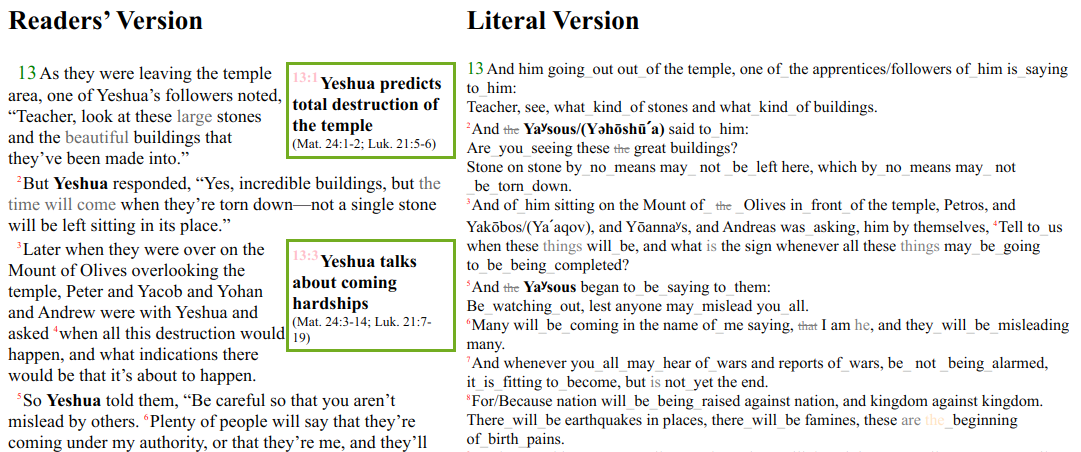
(If you see the typo in the above sample, please come and join our team.)
Read the whole chapter at https://Freely-Given.org/OBD/OET/byC/MRK_C13.htm
Robert Hunt, 23 September 2023